
Enquiries
We would be delighted to hear from you and will respond to your enquiry within 24 hours. Thank you for your interest in Marsh Industries.

How Does a Rainwater Harvesting System Work in a UK Home?
11.24.2026
A rainwater harvesting system collects rain from your roof and pumps it back for your household use (other than drinking) after filtration. It uses free rainwater instead of clean drinking water for jobs that don't need it. For a UK home on a meter, that can save up to 50% of your metered water costs.
Below, we explain exactly how does a rainwater harvesting system work, stage by stage.
What Is a Rainwater Harvesting System?
A rainwater harvesting system collects rain from your roof and stores it for home use. Instead of running down the drain, water flows from your roof and gutters into a storage tank for later.
The whole idea rests on one simple principle:
Capture → Filter → Store → Distribute
Every system of rainwater harvesting for homes follows these four steps, whether it feeds just a garden tap or runs your toilets too. As a result, you get a steady supply of soft, free water for the many household jobs that do not need treated mains water.
How Does a Rainwater Harvesting System Work? The 4 Stages
Here’s what happens to a drop of rain from the moment it lands on your roof.
- Capture: Rain falls on your roof and drains into the gutters, exactly as it does now. The downpipes then carry that water towards the storage tank. Your existing roof becomes the collection surface.
- Filter: Before the water enters the tank, it passes through a filter that removes leaves, moss, and grit. This keeps debris out of your storage. Hence, the stored water stays clean, and the pump stays protected. Moreover, when you choose a good filter, it is self-cleaning. This means less work for you.
- Store: The filtered water collects in a tank, usually buried underground where it stays cool. That matters, because cool, dark storage stops algae and bacteria from growing, keeping the supply fresh until you need it. To store plenty of that clean water, Marsh’s RainCell holds up to 6,000 litres. It suits most household roof sizes.
- Distribute: When you flush a toilet or turn on the garden tap, a pump sends stored rainwater to that outlet. Moreover, if the tank runs low in a dry spell, the system tops up from the mains automatically, so you never run dry.
This cycle repeats every time it rains, which in the UK is often enough to keep a domestic rainwater harvesting tank well supplied through most of the year.
Direct vs Indirect Rainwater Harvesting System: Which Type?
There are three main ways to get stored water to your taps. The direct vs indirect rainwater harvesting system choice comes down to how the water reaches each outlet.
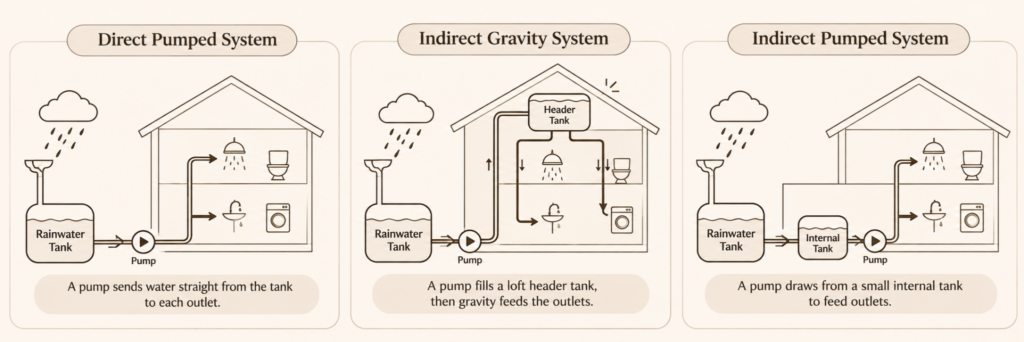
| System type | How it delivers water | Best for |
| Direct pumped | A pump sends water straight from the tank to each outlet | Most homes wanting steady mains-like pressure |
| Indirect gravity | A pump fills a loft header tank, then gravity feeds the outlets | Homes that want power-cut resilience |
| Indirect pumped | A pump draws from a small internal tank to feed outlets | Larger homes needing high, adjustable pressure |
A gravity fed rainwater harvesting system has one standout benefit. As a header tank sits in the loft, your outlets keep working in a power cut, as gravity does the delivery. The pump only runs to refill the header tank, which also keeps energy use low.
A direct system, by contrast, runs the pump every time you call for water, so it uses a little more power for the convenience of simpler installation.
How Much Rainwater Can I Collect From My Roof?
You can work this out in one quick sum. As a rule, 1 mm of rain on 1 m² of roof gives about 1 litre of water. So the answer to how much rainwater can I collect from my roof depends on two things: your roof footprint and your local rainfall.
Use this formula for a realistic estimate:
Usable litres = roof footprint (m²) × annual rainfall (mm) × 0.8
The 0.8 allows for overflow and evaporation losses.
Example: A roof footprint of 80 m² in an area with 750 mm of annual rainfall collects:
80 × 750 × 0.8 = 48,000 litres a year.
To put that in perspective, the Energy Saving Trust estimates the average UK roof collects around 85,000 litres a year. Check your own local figure on the Met Office site, then run the sum for your roof.
The easiest route? Contact Us. Marsh sizes each RainCell from your location, roof type, roof size and the number of people in the house, so the tank matches what your roof can actually supply.
What Can Harvested Rainwater Be Used For?
Harvested rainwater suits any job that doesn’t need drinking-quality water. That covers a surprising share of daily use, since UK homes send around half their water to non-potable tasks. Here’s what can harvested rainwater be used for:
Indoor:
- Flushing toilets, the single biggest indoor use
- Feeding the washing machine with soft, limescale-free water
Outdoor:
- Watering the garden and filling water butts
- Washing the car and cleaning windows
- Cleaning drives, patios and paths
The RainCell Garden covers outdoor use, while the RainCell Home & Garden adds soft water for toilets and the washing machine indoors.
One thing to remember: harvested rainwater is not for drinking, cooking or bathing, so it never replaces your mains supply entirely.
Do You Need Planning Permission for Rainwater Harvesting?
Do you need planning permission for rainwater harvesting? For most homes, a standard underground system does not need planning permission. However, three situations are worth checking first:
- Listed buildings or conservation areas: always confirm with your local planning authority before digging.
- Building Regulations: a system that connects to indoor plumbing must meet Part G and the Water Fittings Regulations, so it keeps rainwater fully separate from your drinking supply.
- New builds: on a new development, rainwater harvesting often forms part of the approved drainage plan from the start.
Learn about septic tank compliance requirements, including General Binding Rules, discharge regulations, drainage field standards and options for upgrading non-compliant systems.
The safest first step is a quick call to your local building control team. They confirm what your specific property needs before any work begins.
Is Rainwater Harvesting Worth It in the UK?
Yes, for most metered homes, it pays off over time. Here’s why rainwater harvesting UK uptake keeps growing:
- Lower bills: A RainCell can cut up to 50% of your metered water costs, since toilets and laundry stop drawing treated mains water.
- Drought resilience: A full tank keeps your garden going through a hosepipe ban, when mains use is restricted.
- Softer water: Rainwater is naturally soft, so it’s kinder to your washing machine and leaves no limescale.
- Greener home: Every litre of rainwater you use eases demand on the public supply, which matters most in the drier south and east.
So is rainwater harvesting worth it UK-wide? A metered household with a decent roof usually recovers it through years of lower bills. The bigger your non-potable use, the faster it pays back.
Collect Your Rainwater, Cut Your Bills
Rainwater harvesting turns your roof into a free water supply for toilets, laundry, and the garden. Start by working out your roof’s yield, then match it to the right tank size and system type. A well-sized system quietly trims your bills for decades.
If your project also needs to manage heavy run-off, a RainCell can sit alongside a wider sustainable drainage system on the same site.
Send your roof size, location and occupant numbers to the Marsh technical team for a RainCell sizing recommendation. We will arrange professional installation to get it running correctly.
Frequently Asked Questions
What maintenance does a rainwater harvesting system need?
Rainwater harvesting maintenance is light but regular. Clean the leaf filter a few times a year, so debris never builds up and blocks the flow. Have the pump and tank checked once a year, and keep a note of each service. A well-kept system runs reliably for many years with very little attention.
How long does a rainwater harvesting tank last?
A quality underground tank is built to last decades, often matching the life of the house itself. The pump and filter are the parts that wear, and both are straightforward to service or replace. Buying a robust, UK-made tank protects that long lifespan from the start.
Does a rainwater harvesting system work in winter?
Yes, and winter is often when UK roofs collect the most. An underground tank sits below the frost line, so the stored water does not freeze. The mains backup covers any rare dry spell, so your toilets and taps keep working whatever the weather.
Can I retrofit rainwater harvesting to an existing home?
Yes, though retrofitting takes more planning than fitting during a new build. You’ll need space to bury a tank and a way to route pipework to the outlets you want to supply. A garden-only system is the easiest retrofit, while a full indoor system is simpler to add during other building work.